
Pregnancy Lower Back Pain

Pregnancy Lower Back Pain

Lower Back Pain after Pregnancy

If you are planning on having a baby or have just had a baby you need to learn more about lower back pain. If you have not yet had a baby or are not yet pregnant you should find out what you can do to prevent lower back pain after your pregnancy. If you have had a baby recently and are experiencing lower back pain there are many things you can do to alleviate your pain. If you are currently experiencing severe pain, you need to see your doctor. You may be referred to a physical therapist or to a chiropractor. Do not attempt to do any exercises mentioned in this article if you are in acute pain.

Strengthening of abdominal muscles

If you are planning on becoming pregnant one of the best things you can do for your body is to strengthen your abdominal muscles. Many lower back pain problems can be traced back to weak abdominal muscles. Therefore if you work on strengthening them before you become pregnant it will be easier to get them back into shape after your pregnancy. This may very well prevent any lower back problems for you after your pregnancy. Some good abdominal strengthening exercises are both bicycle movement that you do while laying on the floor and crunches on an exercise ball. Crunches on an exercise ball are more effective than traditional crunches on the floor.
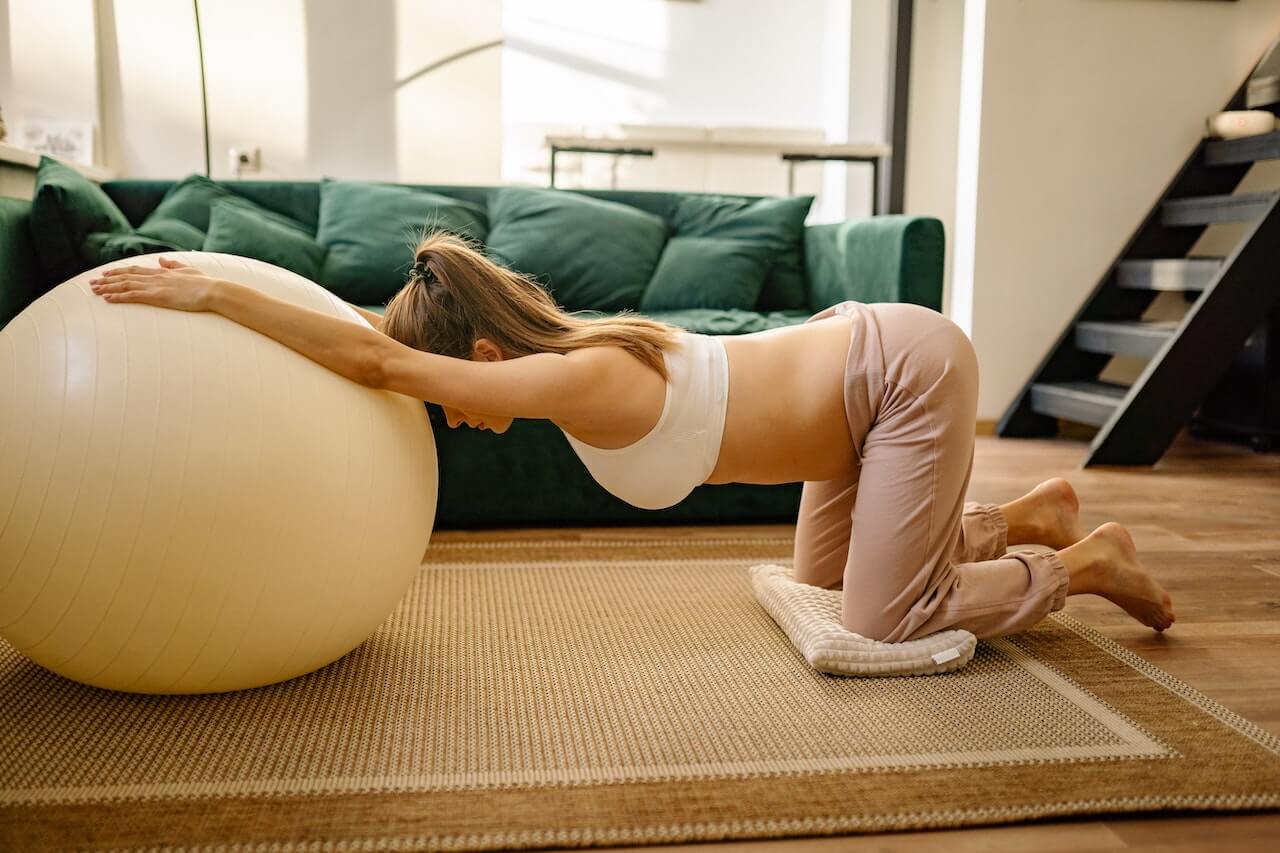
pregnant woman exercises on a ball

Exercise during pregnancy

During pregnancy there are still some abdominal exercises you can do without harming your self or the baby. These exercises usually consist of side crunches, reverse crunches and modified crunches. The modified crunches are done with pillows stacked up behind you so you are not laying flat on the floor. Doing abdominal exercises during pregnancy will help to keep your muscles toned and take the stress off your lower back.

pregnant woman exercises on the floor

Exercise after childbirth

Once you have had your baby you can go back to doing normal abdominal exercises as per your doctor’s instructions. Many women are concerned about what abdominal exercises they can do if they have had a cesarean section. As long as your doctor approves, there are many exercises you can do even if you have had C-section. These exercises will consist of the isometric abdominal contractions, isometric gluteal contractions and Kegel exercises.

If soon after giving birth you need to sit on a chair for a longer time, make it easier for yourself by placing a medical seat pad on the chair.

Relief of back pain

Relief of back pain

How to relieve of back pain with acute symptoms

Relief of back pain – there are two types of back pain acute and chronic. Acute pain is sharp, severe, intense and usually comes on suddenly. Chronic pain is pain that is repeated and/or constant. This article will give you ideas for treating acute symptoms so that you can create back pain relief while you wait to see your doctor or wait for treatment.

Acute back pain

Acute pain can be caused by an injury or chronic problem that may not have been treated until it became acute. Trust me, you’ll know when it’s acute, you won’t need a doctor to tell you that you have acute pain. However, you should see your doctor if you haven’t already.

Even if it hurts, you need to maintain the natural curve in your spine as much as possible. If you sit, be sure to sit without leaning. Use a lumbar roller (or half-roller, depending on the type of backrest) to help you sit properly. While in acute pain, you should sit as little as possible. And only for short periods. If you must sit, choose a sturdy chair. And don’t sit on a soft couch or a soft chair, as this will make it difficult to maintain good posture.

Back pain and driving

Try not to ride in a car or drive alone. However, if you must drive, make sure your seat is far enough away from the handlebars. This will make your arms quite flat. Because if your arms are straight, your upper body will stay in place and that way you won’t lean over. You should always use a lumbar roller (or half-roller) when driving or riding in a car.

hands on the steering wheel of the car

Additional tips – Relief of back pain

You should keep in mind that during acute pain you should not lift a load. Do not sleep on a bed that is too soft. And don’t cough and sneeze while bending forward while sitting. This last tip may sound crazy. If you feel like you’re going to cough or sneeze, try to bend back a little.

One of the most important things you can do when you experience acute pain is to realize that there are ways to relieve back pain. Because you need to give your body time to heal.

Back pain

Back pain

How does back pain start?

Back pain – when we think about back pain, we have to deal with its variants. For example, back pain can start with slipped discs, which is medically called a “herniated nucleus pulposus.” (HNP) Doctors define slipped discs as ruptures of an “intervertebral disc.” Intervertebral lies between the vertebrae (spinal column) of the spine.

Etiology and pathophysiology

The break has variants, including “lumbrosacral” (L4 and L5) as well as cervical C5-7. The cervical part is on the neck and belongs to other parts of the back and neck. When doctors consider slipped discs, they often look through etiology. Etiology includes neck and back sprains, trauma, congenital/congenital bone malformation, weight lifting, degenerated discs, and/or ligament weakness.

After careful consideration, etiology doctors consider the pathophysiology, which includes the protrusions of the “nucleus pulposus”. The center connects to the column or spinal canal and may compress the spinal cord or nerve nucleus or roots. What causes back pain. If the spinal cord is compressed, impeding the roots and brain, often causes pain in the back, numbness and reduced motor functions.

Medical assessments are based on lumbosacral disease, which can include acute or chronic low back pain. The pain can spread to the buttocks and move towards the legs. A person may feel weakness as well as numbness. In addition, such pain can cause tingling around the legs and feet. The final assessment may include ambulation, which emerges from pain.

Consideration of cervical causes

Symptoms that experts look for are neck stiffness, numbness, weakness and “tingling” in the hands. If the neck pain spreads down the arms and continues to the hands, experts will consider sliding discs. Other symptoms may also appear, such as weakness that affects the most distant points or higher boundaries of the body. Lumbar curvature is located in the lower back and is located in the loins or the small of the back, which doctors also take into account, especially if the patient has problems correcting this area with curvature of the spine (scoliosis) and away from the affected area.

Diagnostic

When doctors consider back pain, they will review the diagnosis after conducting a series of tests. Diagnosis can be made based on tendon reflexes, X-rays, EMG, myelogram, CSF and/or Laséque signs. The cerebrospinal fluid helps the doctor to analyze the protein increase. EMG helps specialists in seeing the involvement of spinal nerves. X-rays are used to help specialists see the narrow space in the disc. Tendon reflexes are tested, which doctors use tests to probe deep into the depressed region. Or deficiencies of upper limit reflexes. Which in medical language means, Achilles reactions or reflex. Myelograms help the specialist see if the spinal cord is compressed. Tests begin if Lasègue signs show positive results behind etiologic findings, pathophysiology, evaluations, etc.

How do doctors manage slipped discs?

Doctors prescribe treatment in medical schemes to isolate or relieve back pain. Management schemes may include diet while caloric intake is determined according to the patient’s metabolic requirements. Your doctor can increase your fiber intake as well as increase your fluid intake.

Additional treatment or healing may include hot pads, moisture, etc., as well as hot compresses. Doctors often also recommend pain relievers, such as those for NAID. Pain relievers include

Motrin, Naproxen, Dolobid or Diflunisal, Indocin, Ibuprofen and so on. Additional medications may include muscle relaxants, such as Flexeril and Valiums. Common relaxants are diazepam and cyclobenzaprine hydrochloride, which is diazepam valium, and the other is Flexeril.

Orthopedic devices are also prescribed to reduce back pain, including cervical collars and back braces.

anatomy - back pain